.png?width=1322&height=350&name=C3ITXperts-logo-R%20(1).png "C3ITXperts-logo-R (1)")


Let’s set the scene.
Your school has just spent lakhs of rupees installing state-of-the-art interactive panels.
You survived the installation phase.
The vendor conducted a massive, 4-hour training session on a Saturday.
Everyone took pictures, clapped, and went home.
 And then Monday morning arrives.
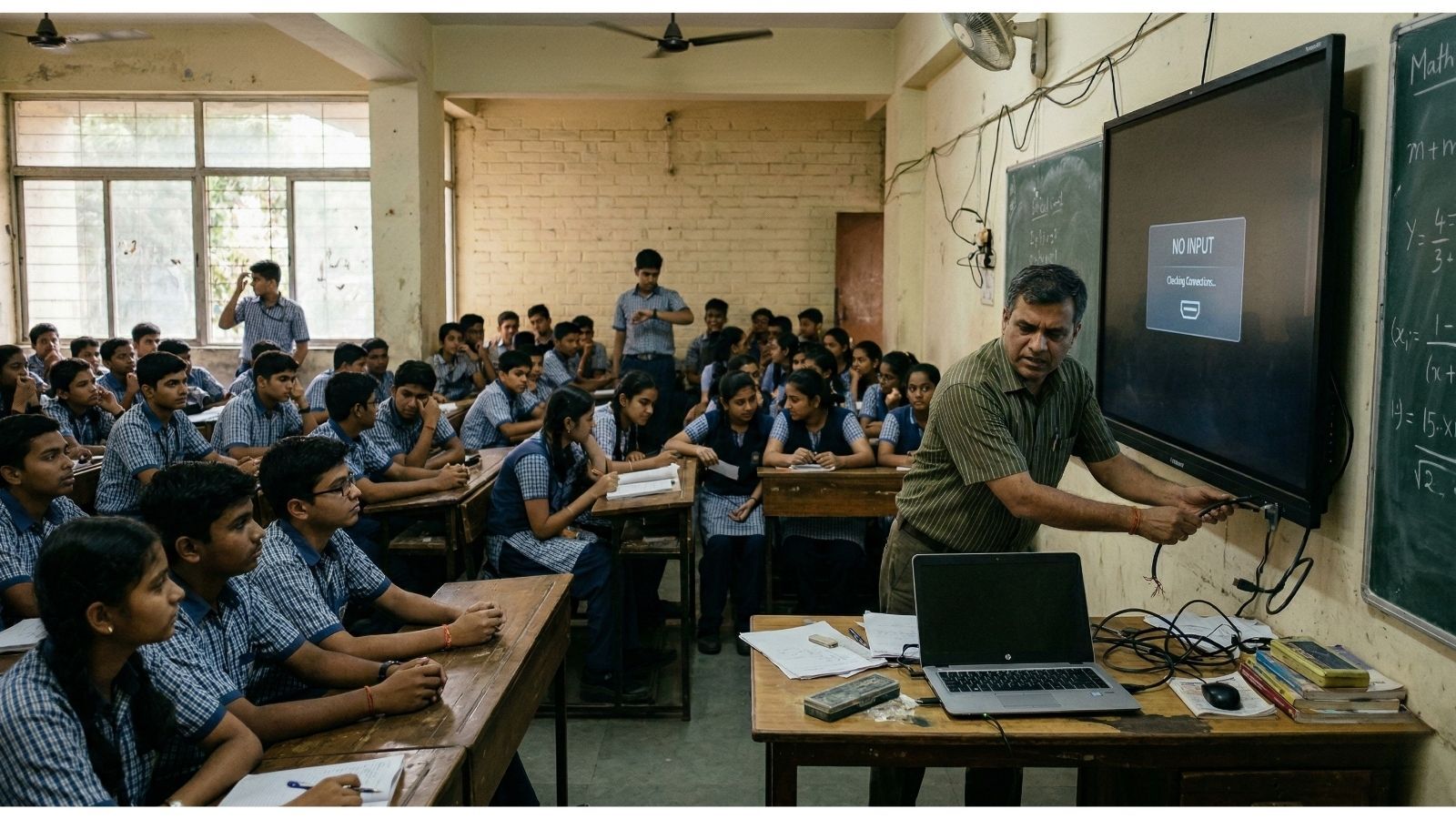
The bell rings. 40 students are buzzing. The teacher walks in. And within three minutes, the panel is ignored, the textbook is opened, and the same old teaching patterns quietly return.
Why?
Most smart classroom initiatives don't fail due to bad technology.
They fail because the daily habits of the classroom never changed.
The difference between a successful smart classroom implementation and one that becomes a glorified, expensive whiteboard isn't the hardware.
It’s the routine.
If you want to rescue your EdTech investment, stop focusing on Saturday workshops and start focusing on what happens from Monday to Friday.
Here are the 7 daily routines that consistently separate high-adoption schools from the rest.
1. The 90-Second Formula 1 Pit Stop
In struggling classrooms, the first few minutes of a period are pure chaos. The teacher is logging in, searching for a file, minimizing pop-ups, and praying the Wi-Fi holds up. Meanwhile, the students have entirely checked out.
In a thriving smart classroom, the start of class looks like a Formula 1 pitstop. Fast, rehearsed, and zero wasted movement. The panel is never turned off between periods (it stays in Smart Standby). The teacher walks in, taps the screen, and the "Hook" of the day is instantly visible. Teaching begins before the students even have a chance to get distracted.
2. The "Anti-Clutter" Rule (One Screen, One Focus)
Have you ever watched a teacher frantically minimize a YouTube ad, close a WhatsApp Web tab, and try to find a PDF while 40 kids watch? It’s painful. It spikes the teacher's anxiety and kills their authority.
Successful classrooms adopt a ruthless rule: One screen. One purpose. The panel is a curated canvas, not a messy desktop. This simple routine reduces the cognitive load on the teacher and gives them the confidence that the lesson is firmly under their control.
3. The "No Dead Air" Transition
In television, "dead air" is when the screen goes blank and the audience changes the channel. The same applies to teaching.
Most instructional time is lost during transitions—moving from a concept explanation to a group activity, or switching from a video to the whiteboard. High-adoption schools treat these transitions like scene changes in a play. The teacher knows exactly what is coming next, and the digital switch happens in less than 5 seconds. The technology disappears, and the flow of the lesson remains unbroken.
4. The 15-Second Pulse Check
Forget the traditional 40-minute lecture followed by a stressful pop quiz. Smart technology allows teachers to take the "pulse" of the room instantly.
A quick digital poll on the screen. A visual show of hands. A fast, interactive drag-and-drop activity. It takes 15 seconds, it lowers student anxiety, and it gives the teacher absolute X-ray vision into who actually understands the concept and who is just nodding politely.
5. The "Clean Slate" Handover
Nothing ruins the momentum of the second period quite like having to clean up the digital mess left behind by the first period.
The best schools enforce a strict 2-minute reset at the end of the bell. The departing teacher saves the digital notes (by exporting them to Google Classroom or the LMS), closes all tabs, and returns the panel to the default home screen. It is the modern equivalent of wiping the chalkboard clean. It is professional courtesy, and it ensures the next teacher starts at zero friction.

📖 Smart Classroom Leadership Series
Mastering digital transformation in Indian schools.
- ✅ Part 1: Why Smart Classrooms Fail (Even After Installation)
- 👉 Part 2: 7 Daily Routines for Success (Current)
- ⏳ Part 3: Reducing Learning Loss: The 90-Second Start
6. The Friday Afternoon Reality Check
Technology adoption doesn't happen during vendor presentations. It happens in the quiet moments of reflection.
Champion teachers spend just 5 minutes on a Friday afternoon asking themselves: "What digital tool saved me time this week?
What felt clunky?
What will I try differently on Monday?"
This tiny feedback loop turns tech-anxious educators into confident power users over a single term.
7. Walking for "Flow," Not Features
When you, as a Principal, walk the corridors, what are you looking for? If you are just checking to see if the panel is glowing brightly, you are missing the point.
You should be looking for flow. Does the teacher look relaxed? Are they tethered to their laptop, or are they moving freely? Are the students leaning in? True digital adoption doesn't look like a sci-fi movie; it looks like great teaching where the technology happens to be invisible.
Stop Buying. Start Designing.
If you recognize the friction in your school while reading this, your next step is not to buy more software. It is to redesign your classroom system.
We have compiled these exact routines (and the strategies to implement them) into a free, comprehensive guide for Indian educators: The Indian School Leader’s Guide to Rescuing Your EdTech Investment.
It will show you exactly how to cure tech-anxiety in your staff room and reclaim hundreds of hours of lost instructional time.
👉 Download the Free Guide Here
About the Author

Manoj Sundaram
Founder @ C3 iT Xperts
I help K–12 leaders turn "dusty" classroom tech into a daily teaching habit. 18 years and 11,000 classrooms have taught me that the best tech is the tech that "disappears" into the teaching rhythm.
18+
Years Experience
11k+
Classrooms
40k+
Educators Impacted
- smart classroom,
- Tech in CBSE Schools,
- School leaders guide,
- SchoolLeadership,
- Edtech India,
- EducationTechnology,
- DigitalTransformation