.png?width=1322&height=350&name=C3ITXperts-logo-R%20(1).png "C3ITXperts-logo-R (1)")


Most schools do not have a content creation problem.
They have a content usefulness problem.
Teachers already spend hours creating lesson plans, slides, worksheets, question papers, revision notes, circulars, and parent communication. School leaders already invest in books, subscriptions, training, and digital platforms.
Yet the same questions keep coming back:
- Why is revision still weak?
- Why are teachers still stretched?
- Why do students ignore resources that took hours to prepare?
- Why does the same lesson need to be recreated in five different formats?
This is where NotebookLM becomes genuinely interesting for schools.
Not because it helps institutions create more random AI content.
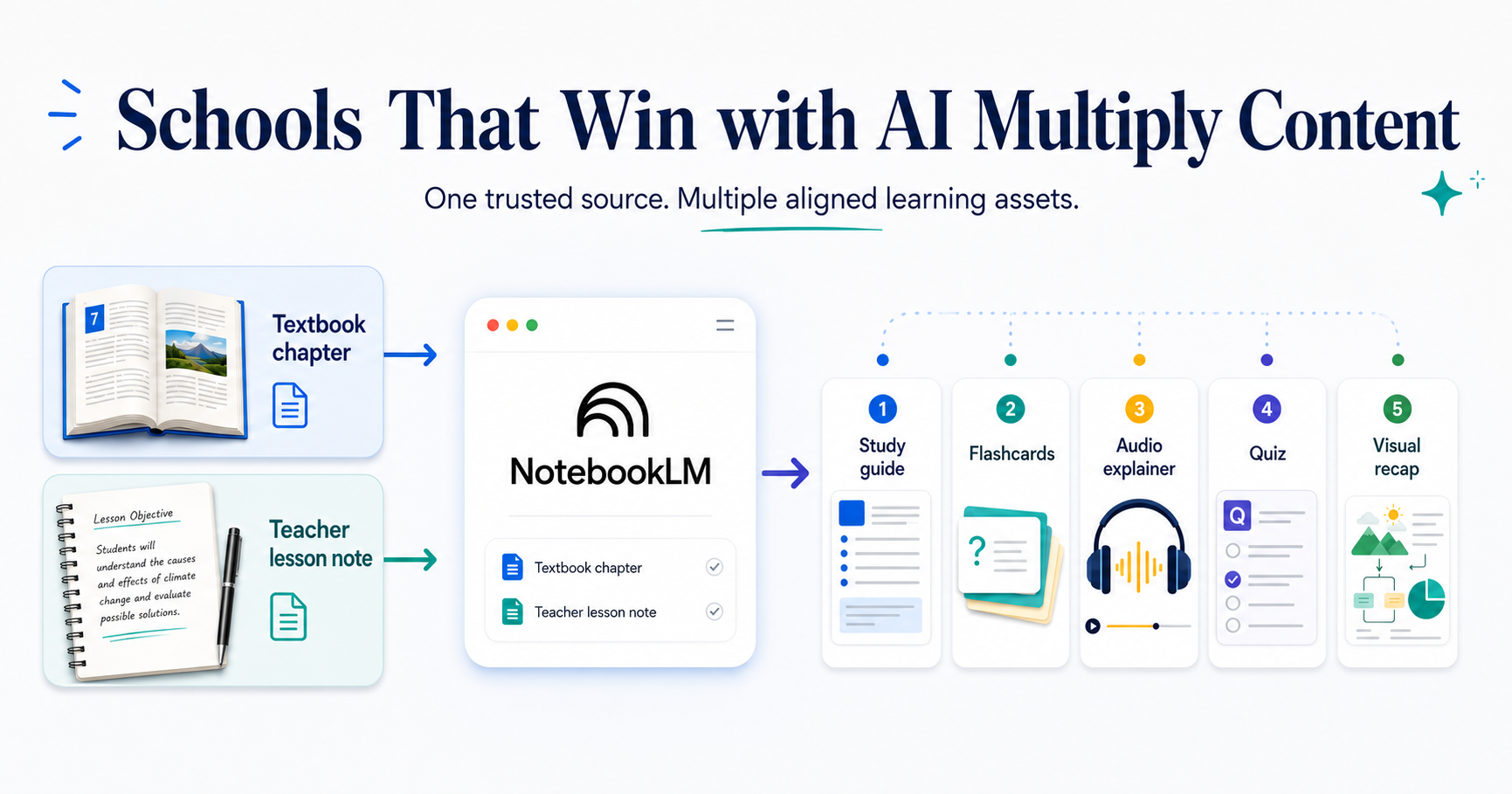
But because it can help schools take one trusted source and turn it into multiple student-ready learning resources.
A textbook chapter.
A teacher’s lesson note.
A school policy.
A concept summary.
A revision handout.
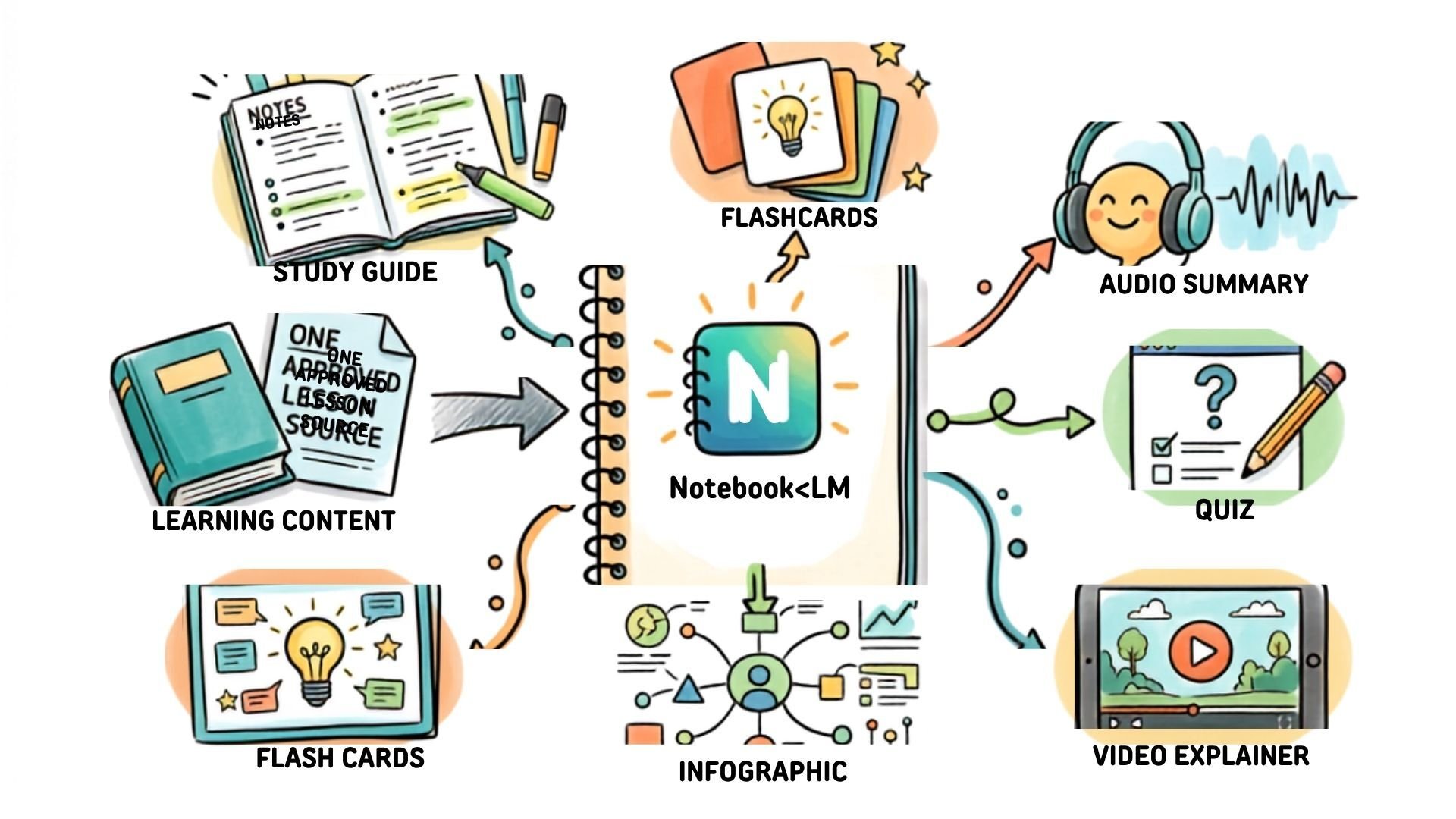
One approved source can become:
- a study guide
- a flashcard set
- an audio explainer
- a quiz
- a visual recap
That is not simply content generation.
That is content multiplication.
And for schools trying to improve learning engagement, academic consistency, and teacher productivity, it is a much smarter place to begin with AI.
Schools already have content. The real challenge is making it useful.
Think about a typical science chapter.
It may be academically sound. It may be aligned to the curriculum. It may even be taught well in class.
But after the lesson, students need different things.
Some need a quick visual recap before an assessment.
Some need flashcards for active recall.
Some need a short quiz to identify gaps.
Some may benefit from listening to a simple explanation again at home.
Some need a clean study guide that helps them revise without reopening an entire chapter.
Traditionally, creating all of this means more work for the teacher.
The teacher has to prepare the lesson, create the revision sheet, write questions, make a quiz, create a recap presentation, and often repeat the same process for every new unit.
That is not sustainable.
The better question is not:
“What more content should we create?”
It is:
“How can we get more teaching value from the content we already trust?”
That is the opportunity NotebookLM creates.
NotebookLM is most useful when schools start with an approved source
Many AI conversations begin with a blank prompt.
“Create a worksheet.”
“Give me a quiz.”
“Make a summary.”
“Write an activity.”
Sometimes that is useful.
But for schools, it can also create a problem: outputs that look polished but are not fully aligned to the textbook, the lesson objective, the teacher’s teaching sequence, or the school’s academic expectations.
A stronger workflow begins somewhere else.
It begins with a source that the school already knows and trusts.
That source could be:
- a CBSE, ICSE, Cambridge, IB, or state-board textbook chapter
- a teacher-created lesson note
- an approved concept summary
- a revision handout
- a school circular
- a policy document
- a faculty training resource
Once the source is approved, NotebookLM can help the school create additional formats around the same material.
This gives school teams three things they cannot compromise on.
1. Academic control
The starting point is already reviewed, accepted, or approved.
The school is not asking AI to invent the academic direction from scratch.
2. Consistency
Every study guide, quiz, flashcard set, or recap begins from the same core material.
That reduces mixed messages across classrooms and departments.
3. Scalability
One lesson does not have to remain trapped in one format.
It can become several useful formats without asking the teacher to restart from zero each time.
The big mistake schools are about to make with AI
Many schools are entering AI from the wrong angle.
They are asking:
“How can AI help us create more?”
More worksheets.
More summaries.
More assignments.
More activities.
More communication drafts.
More reports.
At first, this feels exciting.
But very quickly, it can create a new problem:
more volume, but not more usefulness.
More documents do not automatically mean better teaching.
More summaries do not automatically improve recall.
More resources do not automatically increase student engagement.
And more AI-generated material does not automatically reduce teacher workload.
In fact, disconnected AI outputs can create extra work because teachers still need to:
- check accuracy
- verify academic alignment
- remove irrelevant content
- simplify language
- confirm grade appropriateness
- ensure the resource matches what was actually taught
That is why schools should not treat NotebookLM as “another content generator.”
They should treat it as a source-grounded workflow tool.
The difference is important.
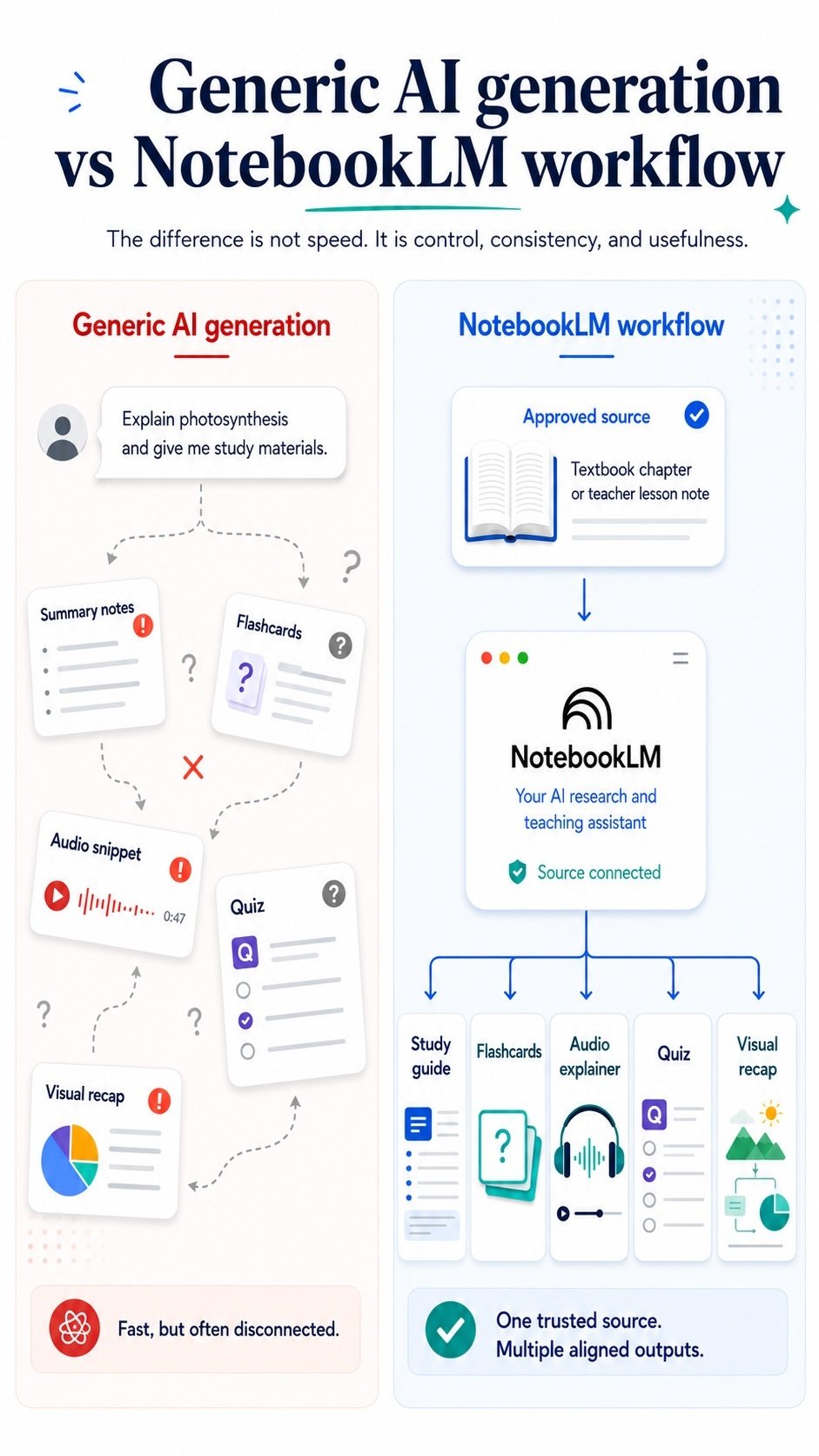
Generic AI often begins with:
“Create something new.”
A source-grounded workflow begins with:
“Help us make this trusted material easier to use.”
That shift changes the quality of the conversation.
What content multiplication looks like in a real school
Let us make this practical.
A science chapter becomes a quick visual recap
A chapter on the water cycle, electricity, photosynthesis, or ecosystems can be dense for students.
Instead of asking students to reread several pages before an assessment, a teacher can create a simplified visual recap that highlights the key concepts, processes, and terms.
Why it matters:
Students get a faster revision route without losing the connection to the original lesson.
A social science lesson becomes flashcards
Dates, definitions, causes, effects, people, places, and terminology are ideal for retrieval practice.
A history, geography, civics, or economics lesson can be converted into flashcard prompts that help students test themselves repeatedly.
Why it matters:
Revision becomes active instead of passive.
A teacher lesson note becomes a quiz
A teacher already knows the learning objective.
That note can become a short formative quiz that helps students check whether they understood the concept before moving ahead.
Why it matters:
Teachers save preparation time while getting a clearer picture of student understanding.
A school policy becomes an audio explainer
Schools often create important documents that are technically available but practically unread.
Parent policies, staff guidelines, child-protection processes, assessment procedures, and technology-use policies can be long and difficult to absorb.
An audio-ready explanation or simple summary can make the information easier to access.
Why it matters:
Important communication gets used instead of simply being circulated.
A revision handout becomes multiple student-ready formats
One revision note can become:
- a printable study guide
- a flashcard set
- a recap quiz
- an audio explanation
- a visual concept map
Why it matters:
The school gets more value from material it has already invested time and expertise in creating.
This is not about replacing teachers
The strongest school AI workflows do not remove educators from the process.
They keep teachers and academic coordinators firmly in control.
The teacher still decides:
- which source is approved
- what the lesson objective is
- what students need at that stage
- whether the output is accurate
- whether the language is grade appropriate
- whether the resource is ready to use
NotebookLM can help multiply the output.
But academic judgment remains human.
That is not a limitation.
That is the advantage.
Because school learning is not only about producing information.
It is about selecting the right information, presenting it at the right level, and using it at the right moment in the learning journey.
A good AI workflow should make teacher expertise more scalable.
It should never make it less important.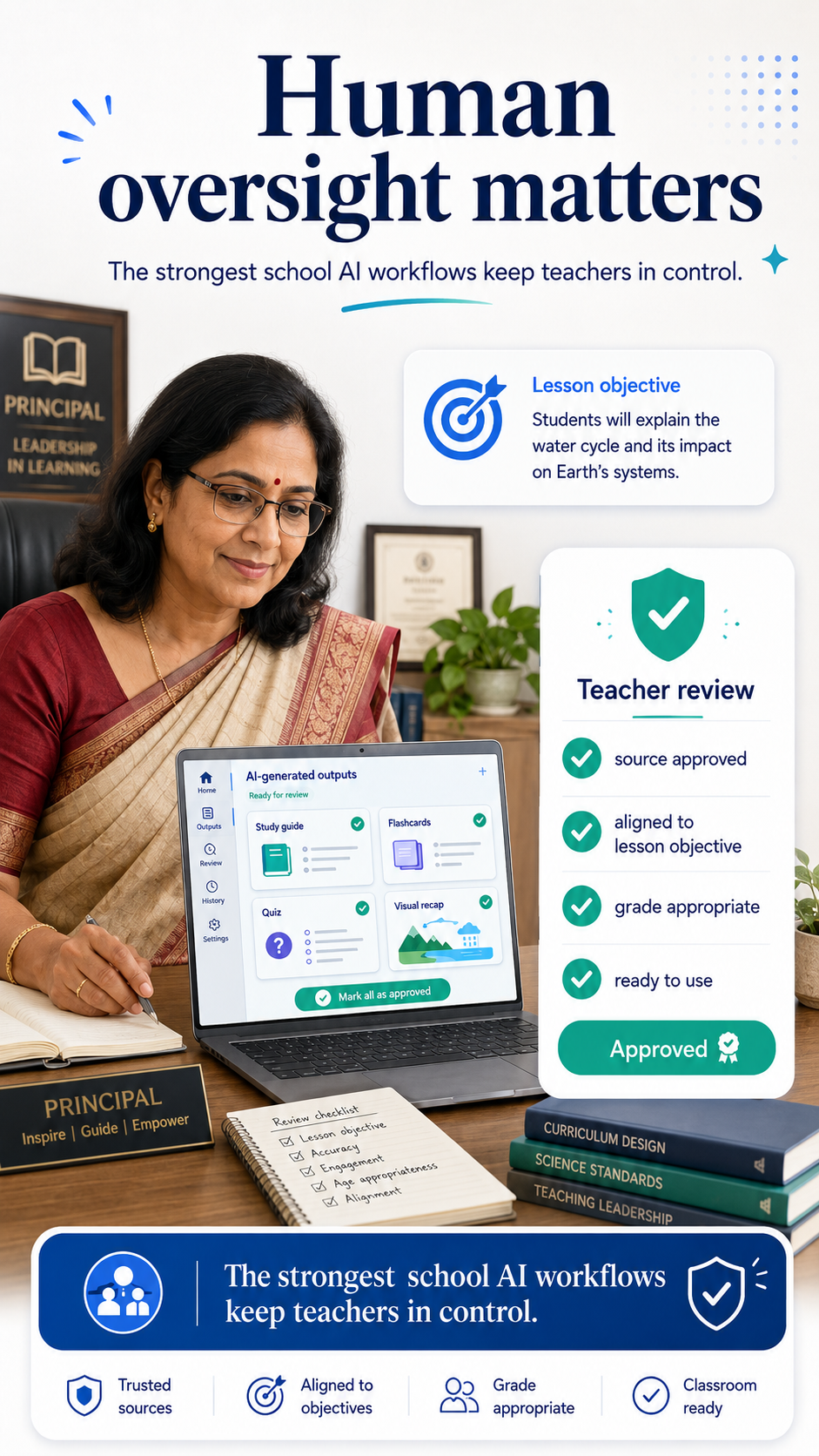
A practical review checklist for every AI-generated resource
Before any AI-generated study guide, flashcard set, quiz, or recap reaches students, schools should use a simple review routine.
Ask four questions:
- Is the source approved?
- Is the output aligned to the lesson objective?
- Is it appropriate for the grade level?
- Is it genuinely ready to use?
This can be reviewed by:
- the subject teacher
- the academic coordinator
- the department head
- the principal or vice principal for major school-wide resources
The process does not need to be bureaucratic.
It just needs to be intentional.
A five-minute review can prevent a resource from becoming confusing, irrelevant, inaccurate, or poorly timed.
A simple NotebookLM pilot schools can start this month
Schools do not need a large AI transformation programme to test this approach.
Start small.
Step 1: Choose one trusted source
Pick one chapter, lesson note, revision sheet, circular, or policy document.
Do not begin with ten subjects or an entire curriculum.
Choose one useful source and test the workflow properly.
Step 2: Decide the learning need
Ask what students, teachers, or staff actually need.
For example:
- faster revision
- active recall
- concept clarification
- parent communication
- teacher reinforcement
- policy understanding
The output should serve a real need, not simply demonstrate that AI can produce something.
Step 3: Create three useful formats
Start with only three.
For example:
- a study guide
- a flashcard set
- a short quiz
Once the school sees value, add an audio explainer or visual recap.
Step 4: Review before use
Use the four-question checklist:
- source approved
- aligned to lesson objective
- grade appropriate
- ready to use
Step 5: Test with a small audience
Try it with:
- one class
- one section
- one subject department
- one parent group
- one staff team
Do not measure success by how many AI resources you create.
Measure success by what people actually use.
Step 6: Observe what works
Ask:
- Did students use the quiz?
- Did the flashcards support revision?
- Did teachers reuse the study guide?
- Did parents understand the policy better?
- Did the process save meaningful teacher time?
- Which format created the most value?
That is how schools move from AI curiosity to practical implementation.
The strategic value for school leaders
The schools that benefit most from AI will not be the ones generating the highest volume of material.
They will be the ones that build better workflows.
Workflows that:
- respect academic control
- reduce teacher effort
- improve access to learning
- create consistency across classrooms
- make existing resources more useful
- give students more ways to revise and engage
- keep educators in charge
That is the real value of NotebookLM in education.
Not more complexity.
Not more dashboards.
Not more documents for the sake of it.
More usefulness.
More reuse.
More clarity.
More value from the content the school has already created and approved.
Final thought
The future of AI in schools will not be decided by who creates the most material.
It will be decided by who makes trusted material easier to use.
When one approved lesson can become a study guide, flashcards, a quiz, an audio explainer, and a visual recap, the school is no longer limited by the format in which knowledge was originally created.
It can deliver that knowledge in the format that helps students, teachers, parents, or staff use it better.
That is not AI replacing teaching.
That is AI helping good teaching travel further.
Ready to test this in your school?
Bring one approved chapter, teacher lesson note, school circular, or policy document to the C3 iT Xperts Experience Centre.
We will help you explore how that one source can become multiple practical learning resources—while keeping academic review and teacher judgment firmly in control.
- Teacher Productivity,
- AI in Education,
- NotebookLM,
- Indian School Leadership,
- Education Technology India,
- K-12 Education Technology


.png)