.png?width=1322&height=350&name=C3ITXperts-logo-R%20(1).png "C3ITXperts-logo-R (1)")


Schools are rushing to talk about AI.
Which tool should teachers use?
Should students use Gemini?
Should we buy Copilot?
Do teachers need prompt training?
Do we need an AI policy?
These are useful questions.
But they are not the first questions.
The first question should be:
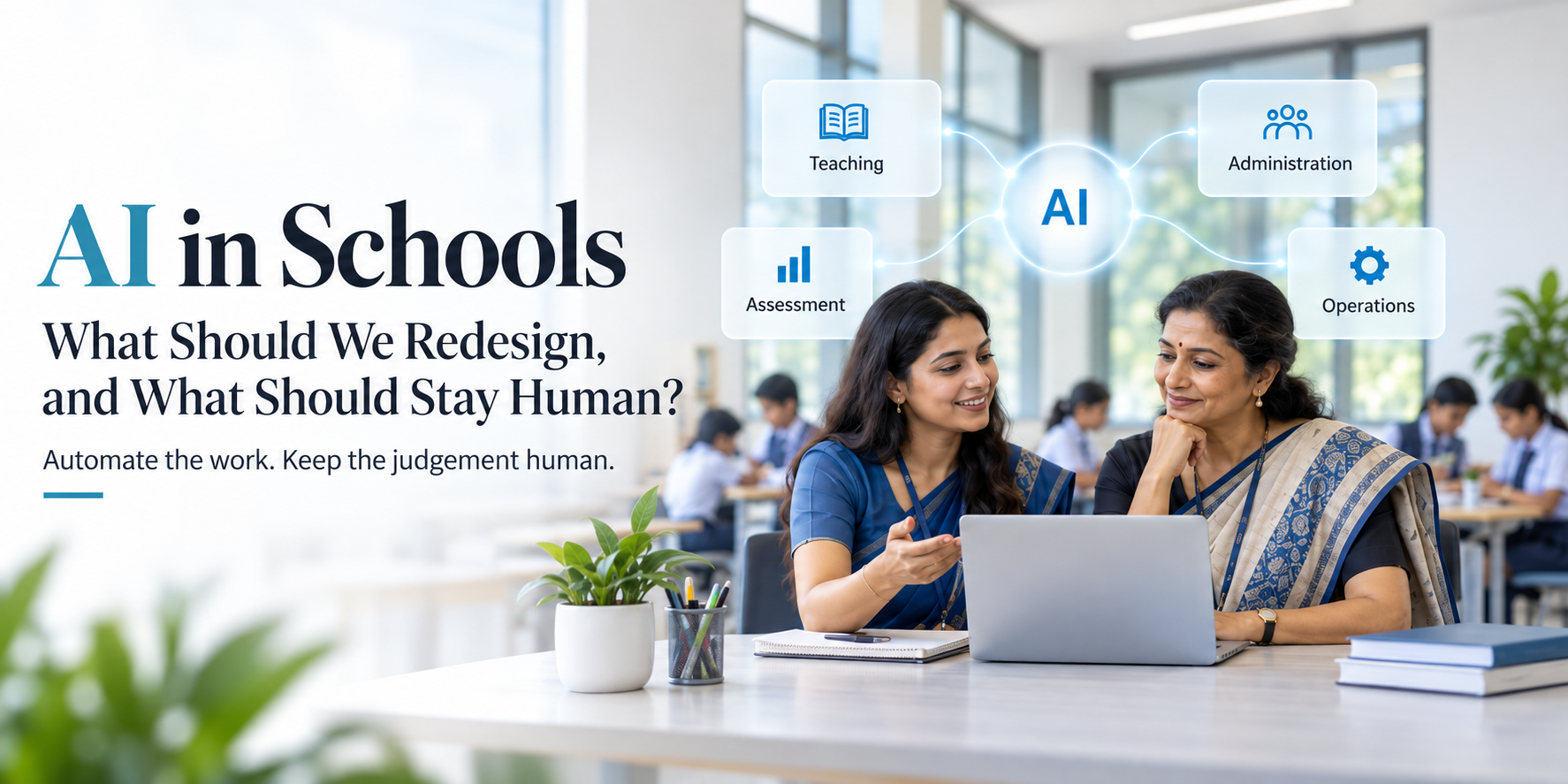
What work should our school change because AI now exists?
And then:
What work should never be handed over to AI?
That is the real AI strategy.
Because adding AI to a poor process does not always make the process better.
Sometimes it simply makes the poor process faster.
Schools have seen this before.
We brought computers into schools.
Then projectors.
Then interactive boards.
Then interactive flat panels.
Then cloud tools.
Then learning platforms.
Each wave promised change.
But in many classrooms, the way teaching happened did not change much.
The blackboard simply became a brighter blackboard.
AI gives schools another chance.
This time, the question should not be:
What should we buy?
It should be:
What should we do differently?
The big idea is simple
AI can help schools do routine work faster.
It can help people find information.
It can help draft, sort, compare, summarise, and analyse.
But there is a line.
Automate the work. Keep the judgement human.
That should be the starting point for every school.
1. Teaching: Reduce preparation work, not teacher thinking
Teachers spend a lot of time before they enter the classroom.
They prepare lessons.
Search for examples.
Create worksheets.
Write questions.
Make slides.
Prepare activities.
Adapt content.
Create revision notes.
Some of this work needs deep teacher judgement.
Some of it is routine.
AI can help with the routine work.
For example, a Class 8 Science teacher is preparing a lesson on photosynthesis.
AI can help create:
- a lesson outline
- a simple explanation
- a classroom activity
- revision questions
- a worksheet
- a quick quiz
- an easier version for students who need help
- an advanced task for students who are ready to move ahead
This can save time.
But the teacher must still ask:
Is this correct?
Will this work for my class?
Is this too easy?
Is this too hard?
Does this example make sense?
Is this suitable for my students?
AI can draft.
The teacher must decide.
AI should reduce preparation work. Not teacher thinking.
That is where AI adds value.
2. Personalised learning may become more practical
Teachers have spoken about personalised learning for years.
The challenge has always been time.
A teacher with 35 or 40 students cannot create five versions of every lesson.
AI can help.
One teacher-approved lesson can be adapted into:
- a simpler version
- more practice
- visual explanations
- vocabulary support
- an extension task
- revision questions
- examples for different learning levels
This is useful.
But the teacher must still decide who needs what.
AI should help the teacher personalise.
It should not take over the teacher's role.
Personalisation should stay teacher-led and AI-assisted.
3. Assessment: The big opportunity is not question creation
Many teachers are already using AI to create questions.
That is useful.
But it is not the big opportunity.
The bigger opportunity is what happens after the student answers.
Think about the normal process.
Teach → Test → Correct → Record → Report
This takes time.
By the time the teacher sees the problem, the class may already have moved ahead.
AI can help shorten that cycle.
A better process could be:
Teach → Assess → Find gaps → Support students → Check again
Imagine 38 students writing a Mathematics test.
AI can help the teacher see:
Which question caused the most difficulty?
Which concept did most students miss?
Which students need extra help?
Which mistake is being repeated?
Which students are ready for the next level?
That is far more useful than simply creating 20 questions.
AI can help find patterns.
The teacher decides what to do next.
AI can also help with feedback
Teachers know feedback helps students.
They also know how much time good feedback takes.
AI can help create a first draft.
For example:
A student submits an essay.
The teacher gives the AI a clear rubric.
AI can draft feedback.
The teacher checks it.
Corrects it.
Adds context.
Then sends it.
That can save time.
But the teacher must still own the feedback.
AI can assist assessment. It should not become the judge.
This line matters.
Because AI should not decide:
- final grades
- student behaviour
- punishment
- promotion
- admissions
- counselling needs
- special support needs
These decisions affect a child.
They need human judgement.
They need context.
Sometimes they need empathy.
AI does not know the whole child.
The teacher does.
4. Administration: This may be where schools see the fastest gain
This is where AI can become very practical.
Look at the amount of routine work happening in a school office.
- circulars
- meeting minutes
- parent messages
- reports
- event notices
- inspection files
- presentations
- staff updates
- policy drafts
- spreadsheet summaries
A lot of this work starts with an empty Word document.
AI can help.
Take a normal school meeting
A Principal finishes a 45-minute meeting.
What happens next?
Someone writes the minutes.
Someone lists the action points.
Someone assigns the task.
Someone sends reminders.
Someone checks what is pending.
AI can help turn meeting notes into:
Summary → Decision → Owner → Deadline → Follow-up
A staff member checks it.
Then sends it.
That is useful AI.
Not because it looks futuristic.
Because it saves an hour of routine work.
Now repeat that across 50 meetings.
That is where the value starts to show.
5. Parent communication: use AI, but do not lose the human touch
Schools send a lot of messages.
Admission replies.
Fee reminders.
Event notices.
Transport updates.
Meeting reminders.
Academic communication.
FAQs.
AI can help draft and organise these messages.
It can also help translate them.
That can save time.
But there is a clear boundary.
A parent complaint should not feel like a chatbot reply.
A bullying issue should not get an automated response.
A serious academic concern needs care.
An accident needs a human voice.
Some communication needs speed.
Some communication needs empathy.
There are parts of a school where being human is part of the service.
That should not change.
6. IT support: Stop solving the same problem again and again
School IT teams deal with many repeated issues.
No sound.
No internet.
Panel not switching on.
OPS not booting.
Wi-Fi not connecting.
Software not loading.
But the solution is often hidden somewhere.
In an old email.
In a WhatsApp message.
In a past ticket.
Or in one technician's memory.
AI can help organise this knowledge.
Imagine a teacher reports:
"The interactive display in Room 304 has no sound."
An AI-assisted support system can help:
- identify the room
- find the device
- check past issues
- suggest simple checks
- create the ticket
- attach the details
- send it to the right person
- escalate it if needed
The technician still fixes the problem.
AI helps with the routine work around it.
That means the IT team spends less time searching.
And more time solving.
7. Procurement: use AI before asking for three quotations
This is one area where schools can make much better decisions.
Many technology purchases begin like this:
"We need interactive panels. Please send three quotes."
But the quote should not be the first step.
First ask:
What is the room size?
How far is the last student sitting?
How many students are in the room?
How will the teacher use the display?
Do we need Windows?
Do we need an OPS?
Do we need USB-C?
What support is required?
How long is the warranty?
What is the total cost over five years?
What training is needed?
AI can help schools organise this information.
It can compare specs.
It can spot missing points.
It can help prepare an RFP.
It can compare vendor responses.
It can highlight major differences.
But again, there is a line.
AI can compare vendors. It should not choose the vendor.
Because vendor selection is not only about specs.
It is also about:
- support
- service history
- training
- project execution
- warranty support
- response time
- trust
AI does not replace those factors.
It simply helps the school ask better questions.
Technology buying should still begin with the requirement.
Not the product.
8. School leaders can use AI to find answers faster
Schools already have a lot of data.
Attendance.
Marks.
Admissions.
Fees.
Support tickets.
Teacher development.
Parent feedback.
Technology usage.
The problem is often not lack of data.
The problem is that the data is in different places.
A Principal may ask:
Which classes have falling attendance?
Which students need extra support?
Which department has the most IT issues?
What are parents complaining about most?
Which technology is being used well?
Today, getting these answers may take days.
AI can help leaders get to the answer faster.
But AI should not make the final call.
AI may tell leaders where to look. Leaders must decide what it means.
That is the difference.
What should schools never hand over fully to AI?
This may be the most important section.
Not everything should be automated.
Schools should be very careful with AI in areas such as:
- teacher appraisal
- student discipline
- recruitment
- termination
- final grades
- admissions
- counselling
- safeguarding
- serious parent complaints
- major buying decisions
- policy decisions
Why?
Because these decisions affect people.
They need judgement.
They need context.
They may need empathy.
They may involve facts that AI does not know.
The rule should be simple:
If the decision can deeply affect a person, AI should assist. A human should decide.
The C3 AI School Redesign Framework
Before using AI in any school process, ask five simple questions.
1. Does this task happen again and again?
If yes, AI may help.
Examples:
Writing summaries.
Sorting information.
Creating drafts.
Preparing reports.
Searching old records.
2. Does someone spend too much time finding information?
If yes, AI may help.
AI is good at searching, summarising, and connecting information.
3. Does this task need human judgement?
If yes, AI should assist.
Not decide.
4. Is student or staff data involved?
If yes, slow down.
Ask:
What data is being shared?
Where is it stored?
Who can see it?
Is the tool approved by the school?
Do not put sensitive student data into random public AI tools.
Convenience is not a data policy.
5. Does AI actually make the result better?
This question is often missed.
AI may save time.
But did the quality improve?
Did the teacher get more time with students?
Did the parent get a better response?
Did IT support become faster?
Did the school make a better decision?
If nothing improved, maybe the school does not need AI there.
Do not start with 50 AI projects
Schools do not need a large AI transformation plan on Day 1.
Start small.
Pick three areas.
For example:
Teaching
Reduce lesson preparation time.
Administration
Reduce the time spent preparing meeting minutes and routine messages.
IT
Build a simple AI-supported support knowledge base.
Run them.
Check the results.
Find the problems.
Improve the process.
Then expand.
This is better than conducting a one-day AI workshop and saying:
"We are now an AI-enabled school."
We have seen that movie before.
Technology was installed.
Training happened once.
Then everyone went back to the old way of working.
AI adoption must be different.
Training will matter more than the AI licence
Buying an AI licence is easy.
Changing work habits is hard.
Teachers need to know:
When should I use AI?
When should I not use it?
How do I check the answer?
What data should I never share?
How do I improve the output?
How do I use AI without reducing student thinking?
How do I know when AI is wrong?
That does not happen in one workshop.
Schools need ongoing learning.
A simple model works better:
Learn → Try → Review → Share → Improve
Then repeat.
That is how AI becomes part of good practice.
From Smart Classroom to AI-ready school
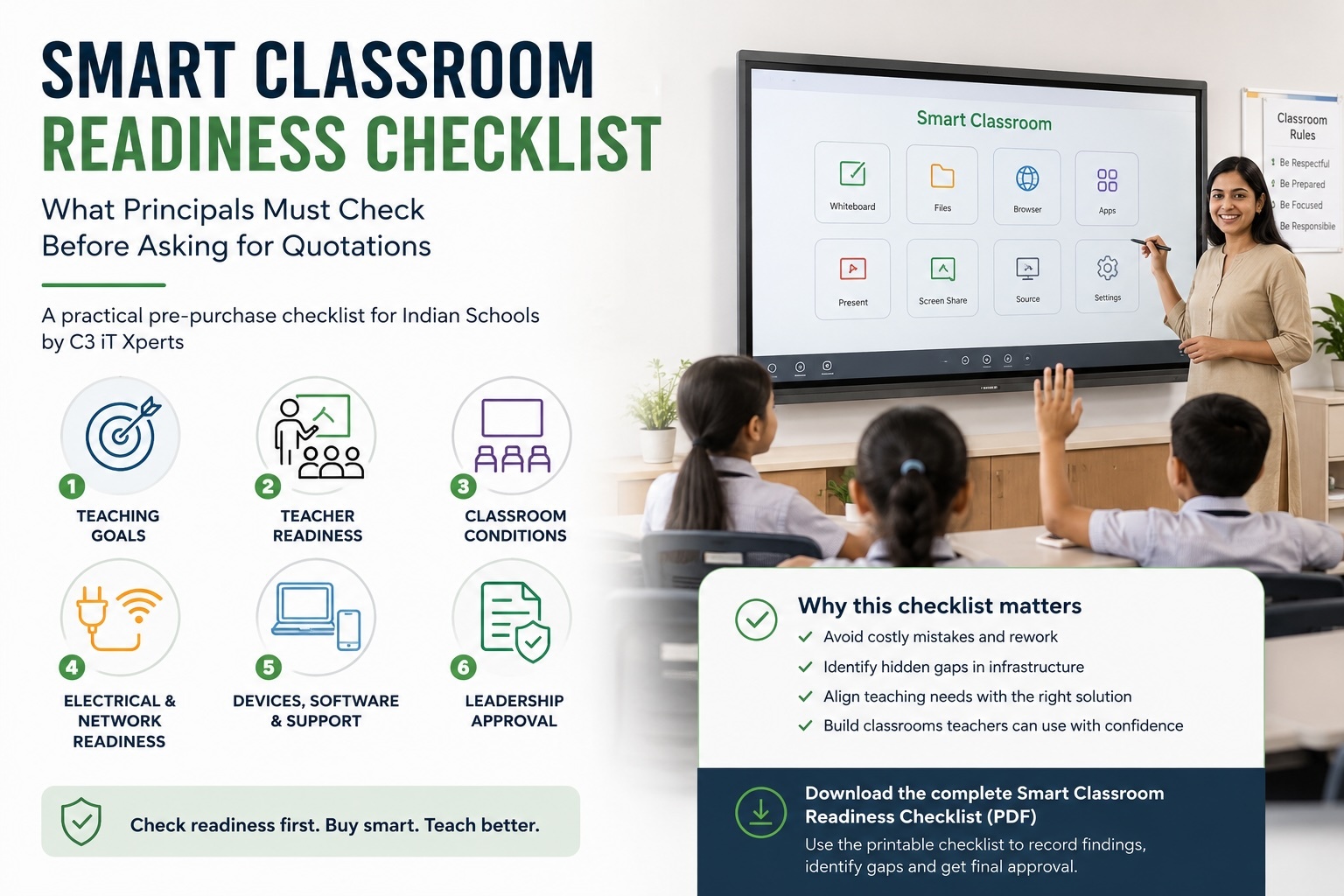
For years, school technology planning was mostly about infrastructure.
Do we have Wi-Fi?
Do we have displays?
Do teachers have devices?
Do we use cloud tools?
Do classrooms have the right technology?
These questions still matter.
But an AI-ready school needs to ask more.
Is our data organised?
Are our processes clear?
Do teachers understand AI?
Do staff know what data they can share?
Which AI tools are approved?
Who owns AI policy?
Which decisions must stay human?
How will we know whether AI is helping?
These are now leadership questions.
Not IT questions alone.
The goal should not be an AI-powered school
This is important.
Schools exist to develop people.
Not to automate everything.
A great school should still have:
Teachers who know their students.
Leaders who walk into classrooms.
Parents who can speak to a real person.
Counsellors who listen.
Students who struggle with hard questions.
Teachers who sometimes change the lesson because the class needs something else that day.
AI is good at handling information.
Education is about people.
Those are not the same thing.
So the goal should not be:
How much can we automate?
The goal should be:
What work can we remove so that people have more time for the work only people can do?
That is a better use of AI.
Before your next AI purchase, ask one question
The first phase of education technology put computers into schools.
The next phase brought digital content, displays, cloud platforms and connected devices.
AI will be different.
It will not only add another tool.
It will change how work gets done.
That is why the first question should not be:
Which AI tool should we buy?
It should be:
Which parts of our school should work differently now that AI exists?
And then ask the harder question:
Which parts should stay human?
Schools that answer both questions well will have a stronger AI strategy.
Not because they use more AI.
But because they use it with purpose.
Because good education technology has never been about how much technology a school owns.
It is about what teachers, students and leaders can do better because of it.
AI should be judged by exactly the same standard.
Planning AI for your school? Start by reviewing your existing technology, workflows, and teacher readiness before adding another platform.
FAQs
What is AI in schools?
AI in schools means using artificial intelligence to support teaching, assessment, administration, school operations and decision-making. AI should assist people rather than replace teacher or leadership judgement.
How can teachers use AI in the classroom?
Teachers can use AI to prepare lesson ideas, create worksheets, adapt content, prepare questions, draft feedback and support different learning levels.
Can AI be used for student assessment?
Yes. AI can help identify patterns, learning gaps and common mistakes. However, final grades and important decisions about students should remain with teachers and school leaders.
How can schools use AI for administration?
Schools can use AI for meeting summaries, circulars, routine parent communication, reports, document preparation and finding information across school systems.
What should schools not use AI for?
Schools should avoid allowing AI to independently make decisions about student discipline, admissions, final grades, staff appraisal, safeguarding or other decisions that strongly affect people.
How should a school start implementing AI?
Start with two or three repetitive workflows. Measure whether AI saves time or improves outcomes. Set clear rules for data and human review before expanding.
About the Author

Manoj Sundaram
Founder @ C3 iT Xperts
I help K–12 leaders turn "dusty" classroom tech into a daily teaching habit. 18 years and 11,000 classrooms have taught me that the best tech is the tech that "disappears" into the teaching rhythm.
18+
Years Experience
11k+
Classrooms
50k+
Educators Impacted